
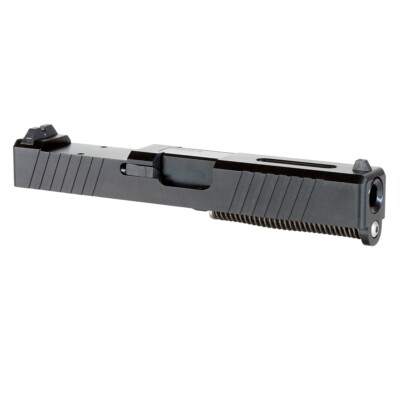
A Glock slide can make or break an optic setup before you ever get to the range. If you are sorting through cuts, plates, generations, and model numbers, this glock optics ready slide guide is built to clear up the fitment questions that cost buyers time and money.
For most Glock owners, the real challenge is not deciding whether a red dot is worth it. It is figuring out which slide actually fits the pistol, matches the optic footprint, and keeps the gun reliable once everything is installed. That matters whether you are building a competition pistol, upgrading a carry gun, or replacing a factory slide with something more refined and performance-driven.
An optics-ready slide is machined to accept a red dot sight. That cut can be done in two main ways. One uses a plate system, as seen on Glock MOS pistols, and the other uses a direct-milled optic cut designed around a specific footprint.
The difference is more than a mounting detail. It affects optic height, sight picture, screw selection, recoil lug support, and how many optic choices you have later. Some shooters want maximum flexibility and like the MOS approach. Others want the lowest possible mount and fewer moving parts, which is where a dedicated milled slide often wins.
A quality slide also does more than hold an optic. It influences cycling, durability, and overall handling. Window cuts, serration patterns, coating quality, and internal tolerances all matter. A slide that looks aggressive but is poorly machined can create more problems than performance.
Before you compare optic cuts, start with the pistol itself. Glock fitment is model-specific and generation-specific. A slide built for a Glock 19 Gen 3 is not automatically compatible with a Glock 19 Gen 5, and a Glock 17 slide is not interchangeable with a Glock 34 just because both are 9mm.
This is where buyers get tripped up. They focus on the optic cut and forget the base platform. The right slide has to match frame dimensions, recoil system design, and barrel length for that model. A mismatch can lead to obvious installation issues or less obvious problems like poor cycling and inconsistent lockup.
For example, compact and full-size Glock platforms serve different roles, and the slide should match that role. A Glock 19 build often leans toward concealed carry or all-around use. A Glock 34 setup is more likely aimed at competition, where a longer sight radius, different balance, and race-oriented features make more sense.
If you are deciding between MOS and a direct optic cut, there is no universal winner. It depends on how you plan to use the gun.
MOS slides are attractive because they give you flexibility. With the right plate, you can run different optics without replacing the entire slide. That makes sense for shooters still deciding between footprints or those who may change optics later. The trade-off is that a plate system adds another interface between the optic and the slide. That can slightly raise the optic and introduces another component that must be installed correctly.
Direct-milled slides are more purpose-built. When the cut matches your optic footprint, the sight usually sits lower and feels more integrated into the slide. That lower mounting position can improve presentation and make suppressor-height sight co-witness easier to manage. The trade-off is obvious: you are committing to that footprint, or at least narrowing your future options.
For a dedicated carry or competition setup, many experienced shooters prefer direct milling because it is clean, strong, and optimized for one job. For buyers who want more flexibility or already own an MOS-compatible pistol, the plate route can still be a smart choice.
Not every red dot uses the same mounting pattern. That is why footprint compatibility matters just as much as model compatibility.
Common footprints include RMR-pattern cuts, RMSc-style cuts for slimmer pistols, and other proprietary patterns used by specific optics. A slide may be advertised as optics-ready, but that phrase alone does not tell you what it accepts. You need to know whether it is cut for a Trijicon RMR footprint, a Holosun variant, a Shield-style optic, or a plate system that adapts to several options.
This matters because screw placement, recoil bosses, and optic body dimensions vary. A poor fit is not just inconvenient. It can affect zero retention and long-term durability under recoil. A proper slide-and-optic pairing should feel engineered, not improvised.
A good optic cut gets attention first, but the rest of the slide still matters. Front and rear serrations improve manipulation under stress, especially with wet hands, gloves, or during one-handed press checks. The pattern should be aggressive enough to grip without feeling like pure cosmetics.
Weight reduction cuts can change the shooting feel, but they are not automatically an upgrade. On some builds, especially competition-oriented setups, reducing slide mass can change recoil impulse and make the gun feel faster. On a carry gun, some shooters prefer a more conservative slide with fewer openings and less chance of collecting debris. Neither approach is wrong. It depends on the role.
Finish quality matters more than many buyers expect. A proper coating helps resist wear, corrosion, and the abuse of regular training. A premium slide should look sharp, but it should also hold up after repeated holster work and real range time.
A carry pistol, range gun, and competition build should not all be treated the same. The best slide is the one that fits the job.
For concealed carry, reliability and simplicity usually come first. A lower-mounted optic, durable finish, and clean serration pattern are often more valuable than aggressive window cuts or the lightest possible slide. You want a setup that presents quickly, stays zeroed, and does not complicate daily use.
For competition, speed becomes a bigger factor. Shooters may favor a longer slide, easier tracking, lighter reciprocating mass, and a cut that pairs with a proven match optic. Here, a more aggressive design can make sense because the gun is tuned around performance first.
For a general-purpose build, versatility matters. That is where many buyers lean toward a proven optics-ready slide with broad support, familiar parts compatibility, and a cut that works with widely used optics. If you want one pistol to do a lot of jobs well, balanced choices beat extreme ones.
The first mistake is assuming all Glock slides within the same model family are interchangeable. Generation details matter. Frame differences, internals, and recoil assemblies can change what works.
The second mistake is buying the optic before confirming the cut. People often pick a red dot based on reputation, then realize the slide they want does not support that footprint without extra hardware or compromises.
The third mistake is ignoring the rest of the build. A slide upgrade works best when it is considered alongside sights, barrel fitment, internals, and intended use. An optic-ready slide is not a magic part. It is one piece of a system.
The fourth mistake is chasing style without asking whether the machining and tolerances are actually there. Sharp looks are easy to market. Precision fit, consistent finish, and reliable function are what matter after the first few hundred rounds.
The safest buying process is simple. Confirm your exact Glock model and generation first. Then confirm whether you want MOS flexibility or a direct-milled optic cut. After that, match the slide to the optic footprint you actually plan to run, not the one you might run someday unless flexibility is your main goal.
From there, evaluate the slide as a performance part. Look at machining quality, serration design, finish, and whether the feature set fits a carry, duty, or competition role. If a slide is built well, the details feel intentional. If it is built for marketing alone, the compromises usually show up quickly.
For buyers who want a specialized source instead of sorting through generic parts listings, Glock Mos Slide Shop exists for exactly this kind of decision. The goal is not just to sell a slide. It is to help you get the right fitment, the right optic interface, and a setup that performs the way a Glock should.
The best optics-ready slide is not the one with the flashiest cuts or the longest feature list. It is the one that matches your Glock, your optic, and the way you actually shoot – because precision only pays off when every part is working in the same direction.