
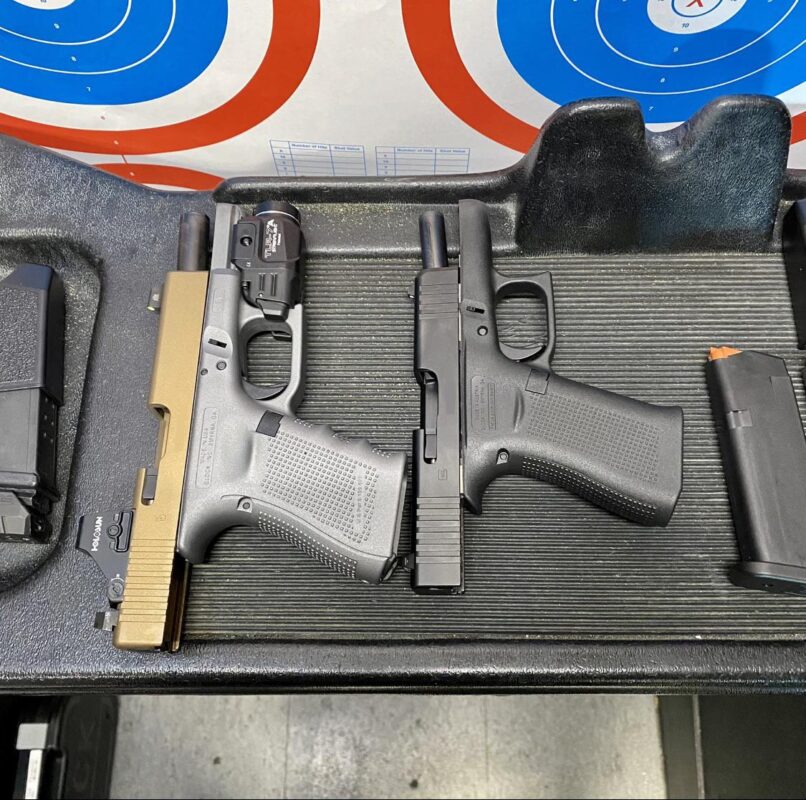
A Glock that prints low-left, throws flyers, or feels harder to track than it should usually is not suffering from a mystery mechanical problem. More often, the issue is a mix of shooter input, sight setup, and a pistol configuration that is functional but not yet optimized for the way you actually shoot. If you are trying to figure out how to improve Glock accuracy, the fastest gains usually come from tightening fundamentals first, then making smart hardware changes that support consistency instead of masking bad habits.
That order matters. Plenty of shooters start with barrels, triggers, and optics, then wonder why their groups still look average. A Glock is already capable of strong practical accuracy out of the box. The real improvement comes from building a system where the gun, the sights, and your technique all work together.
Accuracy problems often begin before the trigger ever moves. A loose or shifting grip changes how the sights return and how the trigger press affects the muzzle. On a Glock, that matters even more because the platform rewards consistency. The lower bore axis helps, but only if your hands are doing the same thing every shot.
Start with firm support-hand pressure. Most shooters underuse the support hand and overwork the firing hand. That creates unnecessary trigger disturbance and often pulls shots off target. Your firing hand should control the pistol, but your support hand should do a lot of the squeezing. That lets the trigger finger move with less interference.
Hand placement matters too. Get the web of your firing hand as high as possible under the beavertail area, then rotate your support hand forward so you maximize contact with the frame. If your hands are shifting during recoil, your group size will show it immediately. Better grip texture, frame work, or even a slide setup that helps balance the gun can make a real difference, but only after your baseline grip is solid.
A surprising number of Glock accuracy issues come down to trigger management. The classic low-left pattern for a right-handed shooter is usually not a barrel problem. It is anticipation, too much finger on the trigger, or a press that turns into a sideways push.
Work on a straight-back trigger press with enough finger to move the trigger cleanly without dragging the frame. For some shooters, that means using slightly more finger than they were taught. For others, it means using less. The right placement is the one that lets the sights stay still through the break.
Dry fire is where this gets fixed. If the front sight twitches at the break, the gun is telling you exactly what is wrong. A few focused sessions of dry fire usually do more for accuracy than a random parts order. Live fire should then confirm what you built in practice, not serve as the first place you diagnose the problem.
After that, a trigger upgrade can help, but this is where trade-offs matter. A cleaner break and shorter reset can improve practical accuracy, especially for faster strings. At the same time, going too light on a carry gun may not be the right move for every shooter. The best trigger setup is not the lightest one. It is the one that gives you a predictable break without compromising the role of the pistol.
If you cannot see the sight picture clearly, your accuracy ceiling drops. That sounds obvious, but many Glock owners are still trying to shoot precise groups with factory plastic sights or a sight configuration that does not match their eyes or use case.
For iron sights, a clean front sight and a rear notch that gives you enough daylight on either side can speed up alignment without feeling vague. If your front sight looks too wide at distance, precision suffers. If the rear notch is too tight, the sight picture can feel crowded and slow.
Optics can be a major upgrade for shooters who want faster target acquisition and more precise aiming, especially at distance. A red dot does not automatically make you more accurate, though. It exposes grip issues, presentation inconsistency, and poor recoil control fast. That is why some shooters love a dot immediately while others struggle for a while.
This is also where slide quality and mounting method matter. An optics-ready setup needs proper fitment, secure mounting, and a slide cut designed for the optic footprint you plan to run. A well-machined slide can improve confidence in the system because the optic sits where it should and stays there. For shooters comparing MOS versus a dedicated milled slide, the right answer depends on how specific you want your setup to be. MOS offers flexibility. A direct-milled slide often offers a lower, more secure optic fit for a dedicated build.
Not all ammo prints the same, even in a reliable Glock. Bullet weight, velocity, and overall consistency affect group size. If you are evaluating your pistol’s true accuracy, test it with quality ammunition before deciding the gun needs work. Cheap range ammo is fine for volume, but it can make a good setup look mediocre.
Barrel upgrades can help, especially if you are chasing tighter groups or building a more performance-focused pistol. But expectations should stay realistic. A match-grade barrel is not a magic switch. If your grip and trigger press are inconsistent, you may not see much benefit. If your fundamentals are solid, better barrel fit and consistency can show up clearly at longer distances.
The same goes for recoil springs and internal tuning. Reliability always comes first. A Glock that runs every time is more valuable than a finely tuned setup that becomes ammo-sensitive or finicky. Any accuracy-focused upgrade should support dependable cycling, not trade it away.
The slide is not just a cosmetic part of the build. It affects sighting options, reciprocating weight, optic compatibility, and how the pistol feels during recoil. That is why shooters who are serious about how to improve Glock accuracy often look beyond the barrel and start thinking about slide design as part of the whole system.
A quality aftermarket slide can open the door to a more refined accuracy setup by giving you a precise optic cut, improved sight compatibility, and weight characteristics that better match your goals. On a competition or range-focused build, that might mean a slide designed around faster tracking and optic performance. On a carry gun, it might mean keeping the setup simpler and prioritizing reliability with practical improvements.
Fitment is where serious Glock owners should pay attention. Model and generation compatibility are not details you can gloss over. A Glock 19 Gen 3 setup has different considerations than a Glock 17 Gen 5 or a slimline pistol. Parts that are technically compatible are not always ideal in execution. Precision matters here, and that is exactly why specialized Glock retailers like Glock Mos Slide Shop exist in the first place.
There is a big difference between bench accuracy and usable field accuracy. If your goal is tighter groups at 25 yards, your training should reflect that. If your goal is faster and more precise defensive shooting inside 10 yards, your practice needs a different emphasis.
For most shooters, the best results come from mixing slow confirmation work with controlled speed. Shoot small groups to verify sights, ammo, and trigger control. Then work doubles, transitions, and draw-to-first-shot drills to make that accuracy hold up under movement and time pressure. A Glock that shoots tiny groups from a rest but falls apart when shot at pace is not fully solved yet.
One smart benchmark is to track what breaks down first. If your groups open up only when you speed up, the issue is probably grip or visual discipline. If they are loose even in slow fire, start with trigger press and sight clarity. Accuracy improves faster when you diagnose the real weak point instead of changing five things at once.
A carry Glock, a competition Glock, and a weekend range build should not all be upgraded the same way. That is where a lot of shooters waste money. They buy parts that are impressive on paper but mismatched to the role of the gun.
If the pistol is for concealed carry, prioritize durable sights, a dependable optic setup if you run a dot, and controls that stay practical under stress. If it is a range or competition build, you have more room to push into lighter triggers, specialized slide cuts, and performance barrels. Neither approach is better on its own. It depends on what accuracy means for that pistol.
The strongest Glock setups are not random collections of premium parts. They are balanced builds. Good grip, clear sights, consistent ammo, and upgrades chosen with a purpose will outperform trend-chasing every time.
If you want tighter groups, cleaner hits at speed, and a Glock that feels more connected to your hands and eyes, think system first. Precision is built one decision at a time, and the smartest upgrades are the ones that make every shot easier to repeat.