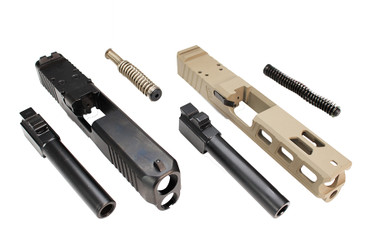
Swap a slide onto the wrong Glock frame and you usually find out fast – either it will not go on, it will not cycle correctly, or it will create the kind of reliability question no serious shooter wants to gamble on. If you are asking will a Glock slide fit another frame, the short answer is sometimes, but only within very specific model and generation combinations.
That is where a lot of buyers get tripped up. Glock pistols look similar across the lineup, and plenty of aftermarket parts are marketed around flexibility. But slide-to-frame fitment is not a guessing game. It comes down to model family, generation, locking block geometry, recoil system design, and whether you are dealing with a standard frame, a slimline frame, or a large-frame platform.
No. Glock slides are not universally interchangeable, and assuming they are can cost you time, money, and performance. Some combinations work cleanly. Others may physically mount but still fail to function the way they should. And some pairings are simply incompatible from the start.
The easiest way to think about it is this: slide fitment usually stays within the same size class and generation range. A Glock 17 slide is built around a full-size 9mm frame. A Glock 19 slide is built around a compact 9mm frame. A Glock 43 slide belongs to the slimline family. Once you jump between those categories, fitment gets complicated fast.
Even when two pistols share the same caliber, that does not automatically make the slide interchangeable. Rail spacing, dust cover length, recoil spring assembly dimensions, and internal tolerances all matter. A setup that looks close on paper can still create cycling problems, poor lockup, or premature wear.
For most Glock owners, the biggest compatibility factor is model family. Standard double-stack 9mm Glocks such as the 17, 19, 19X, 45, 47, and 34 have more crossover potential than slimline or large-frame models, but that crossover still follows rules.
A good example is the Glock 19 and Glock 23. Because they share the same frame size within comparable generations, slide swaps are more straightforward. The same logic applies to the Glock 17 and Glock 22. That does not mean every generation plays perfectly with every other generation, but the physical platform is closer.
By contrast, a Glock 43 slide will not simply drop onto a Glock 19 frame. The widths, rail arrangements, and overall dimensions are different. The same goes for trying to mix standard 9mm slides with large-frame models like the Glock 20 or 21. Those pistols are built on different architectures.
Generation also matters more than many buyers expect. Gen 3, Gen 4, and Gen 5 guns brought changes to recoil spring assemblies, frame dimensions, ambidextrous controls, and slide internals. Those updates affect whether a slide can mount correctly and whether it will run reliably after installation.
If you are comparing Gen 3 to Gen 4 or Gen 5, do not assume fitment based on looks alone. Glock made meaningful engineering changes over the years, and those changes show up where it counts.
Gen 3 models are often the most common base for aftermarket builds because of their broad parts support. Gen 4 introduced a dual recoil spring system on many models, which changed the slide and frame relationship. Gen 5 brought additional updates, including different internal geometry and the removal of the locking block pin on some models. Slide nose profiles and frame dust cover fit can also differ.
That means a Gen 3 Glock 19 slide is not automatically a clean fit on a Gen 5 Glock 19 frame. In some cases, people try to make combinations work with adapters or specific parts changes, but that moves away from straightforward compatibility and into custom gunsmith territory. For a performance-minded shooter, that is a different conversation than simple drop-in fitment.
If your priority is reliability, stick to slide and frame pairings that are specifically built for the same model and generation, or explicitly engineered for a known crossover setup.
The most common questions usually center on the 17 and 19 families. That makes sense. They are two of the most popular Glock platforms, and many shooters own both.
A Glock 17 slide does not fit a Glock 19 frame in the standard sense. The 17 slide is longer, and the frame dimensions are not a direct match for a normal drop-on installation. However, crossover pistols like the Glock 45 and Glock 47 changed the conversation. Those models were designed with compatibility in mind, and they created a more modular relationship inside the Gen 5 9mm family.
For example, the Glock 47 slide can pair with a Glock 19 Gen 5 frame because it uses a recoil system arrangement that supports that configuration. That is not the same thing as saying any Glock 17-length slide will fit any compact frame. It works because those specific models were designed around that shared geometry.
The Glock 19 and Glock 23 are another common example. Since they share the compact double-stack frame size in comparable generations, slide swaps are more plausible. But caliber differences still affect barrels, extractors, ejectors, and magazine setup. Physical fit is only one part of the equation.
Then there are long-slide models like the Glock 34. Shooters often want the extra sight radius and competition look, but a Glock 34 slide is tied to the full-size 9mm frame family. It is not a universal upgrade path.
This is where serious Glock owners separate appearance from performance. A slide may physically travel on the frame rails, but that does not guarantee proper lockup, recoil control, extraction, ejection, or safe operation.
Tolerance stacking matters. So does spring weight. So do internal parts and frame geometry. If the recoil spring assembly is not matched to the slide and frame combination, you can get short cycling, feeding issues, or inconsistent return to battery. If slide internals do not align with the trigger housing and ejector setup in the frame, reliability can suffer.
That is especially true with aftermarket slides. Quality matters. Precision machining matters. Model-specific engineering matters. A slide cut for a Glock 19 Gen 3 should be treated as exactly that, not as a maybe-fit option for anything that looks close.
For buyers focused on optics-ready performance, this becomes even more important. Once you add an optic, suppressor-height sights, a threaded barrel, or a compensator, every tolerance choice starts to matter more. The wrong fitment foundation turns a performance upgrade into a troubleshooting project.
Start with the exact model, then the exact generation, then the frame category. That order matters.
If the slide and frame are from the same model and same generation, fitment is usually straightforward. If they are from the same family but different generations, you need to verify whether recoil spring design, internal parts, and frame geometry still line up. If they are from different size classes, assume they do not fit unless you have confirmed a known-compatible pairing.
You also need to account for caliber. A frame may accept a slide from a closely related model, but true function still depends on matching the barrel, extractor, ejector, magazines, and spring system to the build.
This is why model-specific shopping matters. A serious retailer that specializes in Glock slides should make generation, model, optic cut, and platform details crystal clear. At Glock Mos Slide Shop, that model-by-model focus exists for a reason – fitment accuracy is part of performance.
If your goal is a dependable carry gun, your tolerance for experimentation should be low. A custom crossover build might be interesting on the bench or at the range, but defensive reliability comes first.
The same caution applies if you are new to Glock platform differences. It is easy to confuse what can be made to work with what should be trusted. Those are not the same standard.
If you want a better optic setup, improved slide serrations, reduced weight, or a cleaner custom look, the smarter move is usually buying a slide cut specifically for your Glock model and generation. That gives you the benefits you want without introducing unnecessary fitment variables.
A Glock platform rewards precision. The better the parts match, the better the pistol tends to run. If you are wondering whether a certain slide and frame combination works, treat the answer like a build spec, not a rumor. The right fit is not just about getting the slide onto the frame. It is about keeping performance, reliability, and confidence exactly where they belong.