If you have been shopping for a Glock upgrade and keep seeing MOS in product names, you are looking at one of the most practical changes to modern pistol setup. So what is a Glock MOS slide? In plain terms, it is a Glock slide designed to accept a red dot optic through a factory optics-ready mounting system instead of requiring the slide to be custom milled first.
For shooters who want faster target acquisition, a cleaner sight picture, and a pistol that is ready for modern optics, that matters. But the details matter too. Not every MOS setup works the same way, not every optic fits every cut, and not every shooter is better served by MOS over a direct-milled slide.
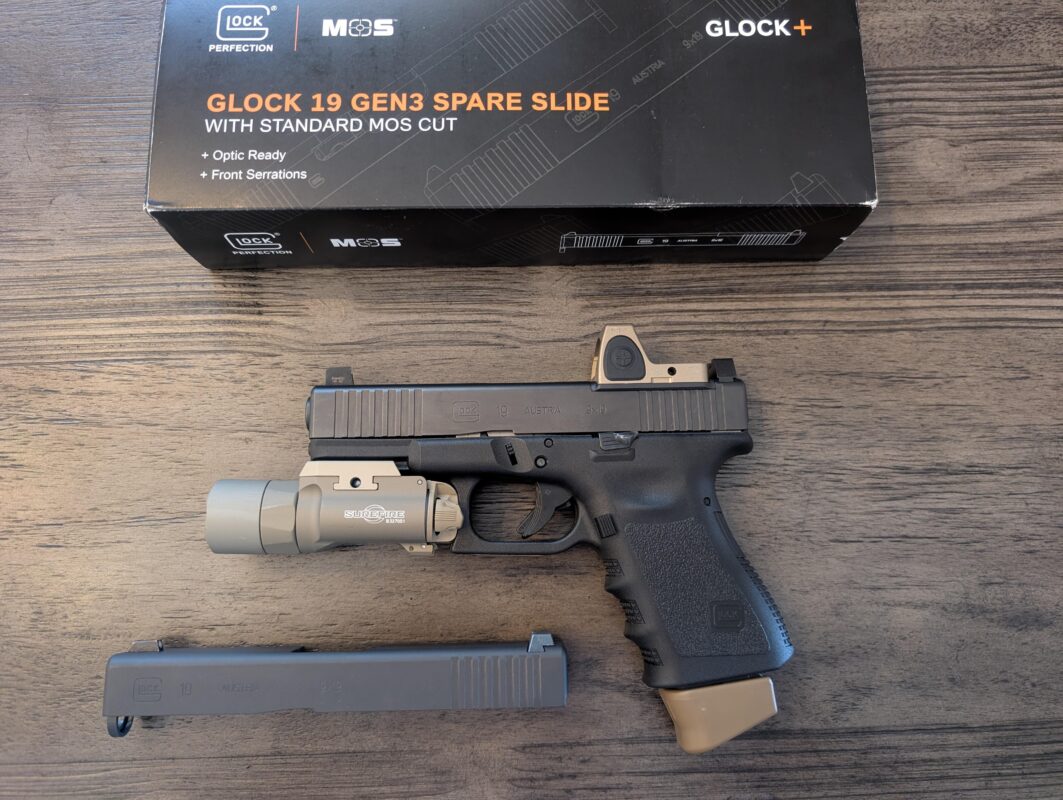
MOS stands for Modular Optic System. On a Glock MOS slide, the top rear portion of the slide is cut to accept adapter plates. Those plates let you mount certain pistol optics without having the slide permanently machined for one specific footprint.
That is the real value of the MOS design. It gives Glock owners flexibility. Instead of committing to a single optic standard from day one, you can use the proper plate to match the optic footprint you want to run.
A standard Glock slide does not have that optics cut. If you want to mount a red dot on a non-MOS slide, you usually need aftermarket milling, a replacement optics-ready slide, or a rear-sight dovetail mount, which is generally a compromise compared to a proper slide cut.
With an MOS slide, the optic mounting area is built into the slide itself. The plate interfaces with the slide, and the optic mounts to the plate. That layered setup is what makes MOS convenient, but it is also where fitment quality becomes a serious factor.
The biggest reason is simple: red dots work. For many shooters, especially those training regularly, running defensive drills, or competing, a pistol optic can improve target focus and speed up sight acquisition once the presentation is dialed in.
An MOS slide gives you a straightforward way to get there. You are not starting with permanent machine work. You are starting with an optics-ready platform that gives you options.
That flexibility is appealing for a few different types of Glock owners. A concealed-carry user may want to try a compact optic but keep future options open. A range shooter may be comparing brands before settling on one long term. A builder working on a Glock 17 Gen 3, Glock 19, or Glock 34 setup may want an optics-capable slide that also improves the overall look and performance of the pistol.
There is also the resale and upgrade angle. Because MOS-style slides are built around optics readiness, they fit the direction a lot of Glock owners are already heading. A pistol set up for irons only can still work extremely well, but optics-ready hardware is no longer a niche feature.
A standard Glock slide is built for iron sights only unless it has been modified. It is simple, proven, and often the most budget-friendly route if you have no intention of adding an optic.
An MOS slide adds the optic cut and usually uses adapter plates. That means more capability, but also more components in the stack. The upside is modularity. The trade-off is that you now care a lot more about screw quality, plate quality, optic footprint compatibility, and proper installation torque.
For some shooters, that trade-off is completely worth it. For others, especially those who already know the exact optic they want to run forever, a direct-milled slide may be the tighter and lower-profile solution.
This is where a lot of buyers get stuck.
An MOS slide is modular. A direct-milled slide is purpose-cut for a specific optic footprint. If you run an RMR-pattern optic on a direct-milled slide, the optic can often sit lower and fit more tightly because the slide was cut specifically for that footprint.
That usually means a cleaner mount and, in many setups, better recoil lug engagement or less reliance on intermediary plates. For hard-use shooters, that can be a major advantage.
But direct milling is less flexible. If you change optics later and the new optic uses a different footprint, your slide may no longer work without additional machine work. That is the part many first-time buyers overlook.
MOS slides sit in the middle ground. They are a strong choice for shooters who want optics readiness without locking themselves into one exact optic from the start. For a lot of Glock owners, especially those still comparing red dot options, that is the smarter first move.
The honest answer is: it depends on the plate system and the optic footprint.
A Glock MOS slide does not directly fit every optic by itself. The slide uses a mounting cut that works with specific adapter plates, and those plates are matched to optic footprints. Popular optics may include RMR-pattern, DeltaPoint Pro-pattern, Docter-pattern, and other common footprints depending on the slide and plate system.
This is why compatibility research matters before you buy. You are not just matching a Glock model. You are matching the slide cut, the plate standard, the optic footprint, the screw set, and in some cases suppressor-height sights for co-witness.
That sounds like a lot, but it becomes manageable once you break it down by platform. Start with your pistol model and generation. Then confirm whether the slide is factory MOS or aftermarket MOS-compatible. After that, verify the exact optic footprint and plate requirement.
If there is one place not to guess, this is it.
No, and that is where buyers can make expensive mistakes.
Factory Glock MOS slides follow Glock’s own system, but aftermarket optics-ready slides can vary in dimensions, plate support, finish quality, machining tolerances, and which generations they fit. A Glock 19 Gen 3 slide is not automatically interchangeable with every Glock 19 variant. The same goes for slimline versus double-stack platforms and model-specific internals.
Some aftermarket slides are made specifically for certain builds and offer aggressive serrations, window cuts, improved coatings, and enhanced styling. Those upgrades can reduce weight, improve manipulation, and sharpen the pistol’s overall look. But visual appeal should never outrank fitment and reliability.
A good slide needs to do more than look fast. It needs to cycle correctly, maintain proper tolerances, and support the optic mount with consistent machining. Precision matters here because tiny inconsistencies at the mounting surface can create big problems over time.
For many shooters, yes. But it depends on how you use the pistol.
If you know you want to run a red dot and want flexibility in optic choice, an MOS slide is often worth the investment. It saves you from sending out your original slide for custom work, and it keeps your build path open. That is especially useful if this is your first optics-ready Glock setup.
If you are a competitive shooter or serious enthusiast chasing the lowest optic position and the most dedicated mount possible, direct milling may still be the stronger option. And if you are perfectly happy with irons and want maximum simplicity, a standard slide may be all you need.
The right answer is not always the most expensive setup. It is the setup that matches your intended use, your optic plan, and your tolerance for future changes.
Before you buy, confirm your Glock model and generation first. Then check whether the slide is stripped or complete, whether it requires specific internals, and which optic footprints or plate systems it supports.
You should also look at material, coating, machining quality, and sight compatibility. Some shooters want blacked-out suppressor-height sights to pair with a dot. Others want a clean optic-only presentation. There is no universal best setup, only the right one for your use case.
This is also where specialized retailers matter. Shops focused on Glock slides and optics-ready components, including Glock Mos Slide Shop, tend to provide the model-specific detail buyers actually need instead of broad, vague fitment claims.
A Glock MOS slide is an optics-ready slide built to let you mount a pistol red dot using a modular plate system. Its biggest advantage is flexibility. You get a path into red dot shooting without committing to permanent custom milling on day one.
That does not make it the right answer for every shooter. Some builds benefit more from direct milling, while others are better left simple with iron sights. But if your goal is a modern Glock setup with room to adapt, an MOS slide is often the smartest place to start.
Choose for fit, function, and intended use first. The right slide should not just mount an optic – it should make the whole pistol feel more capable every time you press out on target.